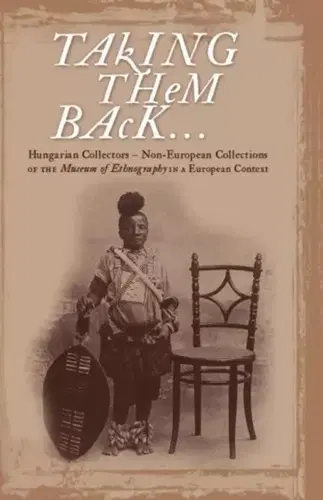
Taking them back - János Gyarmati
The Museum of Ethnography and its exotic collections. The Department of Ethnography of the Hungarian National Museum was founded in 1872, a year before the establishment of the Ethnologisches Museum in Berlin and three years before the creation of the k.u.k. Naturhistorisches Hofmuseum in Vienna. In terms of its foundation date alone, the department from which the Museum of Ethnography eventually developed did not lag behind similar Western European museums at the moment of its birth. The sad fact is that compared to major European museums, the Museum of Ethnography was at an insurmountable disadvantage from the moment it was born since it had but a single collection at the time, namely the one on which its creation was based. The Hungarian National Museum was founded exactly seven decades earlier, in 1802, from the private collection of Count Ferenc Széchényi, whose collecting activity did not extend to Hungarian peasant culture or the culture of non-European peoples. The latter can perhaps be attributed to the fact that royal collections resembling the ones in Western Europe did not evolve in Hungary, a country which for long centuries was part of the Habsburg Empire, while the emergence of aristocratic and other collections was seriously inhibited by the more modest wealth of the country’s elite, as well as by the lack of independent trade relations and overseas colonies owing to the subordination to Vienna and, even more importantly, the apparent lack of interest in the collection of artefacts from overseas regions. Even the Fejérváry Collection, one of the most outstanding private collections in Hungary created in the early 19th century, included but a handful of oriental pieces, and no more than a few American and African artefacts (BINCSIK 2005; GYARMATI 2005b). Even these items were taken out of Hungary when Ferenc Pulszky, the later director of the Hungarian National Museum, sold the collection he had inherited during his émigré years in London following the crushing of the 1848–1849 Revolution and War of Independence (GIBSON–WRIGHT 1988). The fate of Antal Reguly’s Siberian collection assembled between 1843 and 1846, during his research of the prehistory of the ancient Hungarians, is a sad illustration of this situation. Reguly’s ethnographic and archaeological artefacts arrived to the Hungarian Academy of Sciences in 1847.[1] The collection was displayed to the public and then taken to the Hungarian National Museum, where it remained packed in the crates in the museum’s corridors (JANKÓ 1902a:338; BALASSA 1954:50). One part of this collection became dispersed (PÁPAI 1890:117– 118) or perished. The Department of Ethnography eventually received and inventoried 58 items, of which no more than 42 can be identified today following the transfers to other museums and the deaccessions (KODOLÁNYI 1959:301).
Podobné produkty